











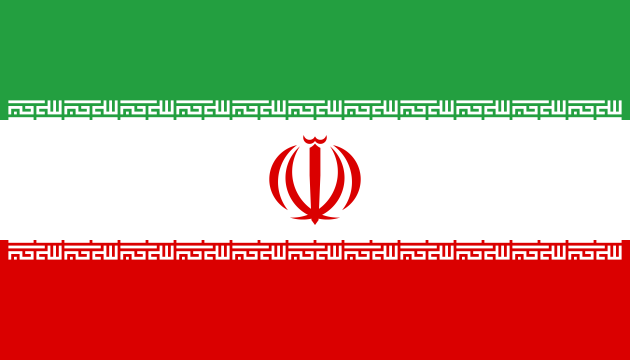
Iran's football team will have more time on American soil ahead of their final FIFA World Cup group-stage match, after the US Department of Homeland Security revised the entry conditions applied to the squad.


World Cup 2026
Iran Granted Extra Preparation Time for Seattle World Cup Clash Against Egypt
60 minutes ago·3 min

Iran's football team will have more time on American soil ahead of their final FIFA World Cup group-stage match, after the US Department of Homeland Security revised the entry conditions applied to the squad.
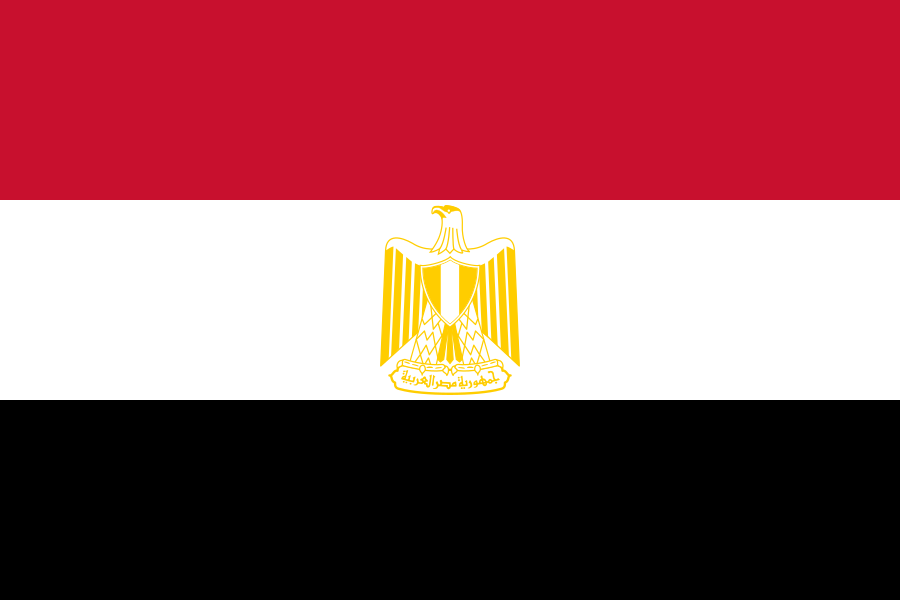
For their third group game — against Egypt in Seattle on 26 June — Iran will be permitted to arrive in the United States two days before kick-off. That represents an additional day beyond the 24-hour window the team was granted for its opening two fixtures in Los Angeles.
However, the squad will still be required to depart on the day the match concludes, returning to their base camp in Tijuana, Mexico.
"For the Iranian team's third match in Seattle on 26 June, the team has been permitted to come into the US two days before the match. The Iran team will still be required to leave the day the match ends," the Department of Homeland Security said in a statement. "The overall security measures and protocol are the same. We remain committed to providing the safest tournament possible for players, staff and fans alike."
Complaints and pressure from the Iranian federation
The revision follows pressure from the Iranian Football Federation, which had announced plans to file a formal complaint with FIFA over what it described as unequal treatment compared with other nations at the tournament.
Under the previous terms, Iran's squad was only permitted to enter the United States the day before each match and was required to leave the same day the game ended — conditions that head coach Amir Ghalenoei publicly condemned.
Ghalenoei described his side as the "most oppressed" team at the tournament, arguing they had been "robbed" of preparation time and given "less than half" the training window the squad needed. Other competing nations, he noted, faced no such restrictions.
Last week, Andrew Giuliani, executive director of the White House's World Cup task force, indicated that discussions were under way to adjust arrangements for the Seattle match. Giuliani acknowledged that tighter restrictions for the first two games in Los Angeles were reasonable given the short flight from Tijuana, but accepted that the longer journey to Seattle — up to three hours — warranted a rethink.
Ghalenoei had repeatedly called for Iran to be allowed into each host city two days before a match and to return to base the following day, "in order to achieve optimal technical and physical preparation."
At a press conference before Iran's second group game, the coach said his side had faced "many challenges off the pitch" and that "this kind of behaviour is not suitable for the World Cup," adding that the restrictions were incompatible with football's values. "We are here for football, not politics," he said.
The Iranian Football Federation echoed those sentiments in a statement to the BBC: "Such restrictions are inconsistent with the principle of providing equal conditions for all participating teams and may negatively affect teams' preparation processes."
Comments
Share
Comments
Be the first to comment.