


The Premier League has sent more players to the World Cup semi-finals than any other domestic competition — but if you want to find them on the pitch, look to defence rather than attack.


Premier League
Premier League Dominates World Cup Defences But Misses Out Up Front
2 hours ago·3 min

The Premier League has sent more players to the World Cup semi-finals than any other domestic competition — but if you want to find them on the pitch, look to defence rather than attack.
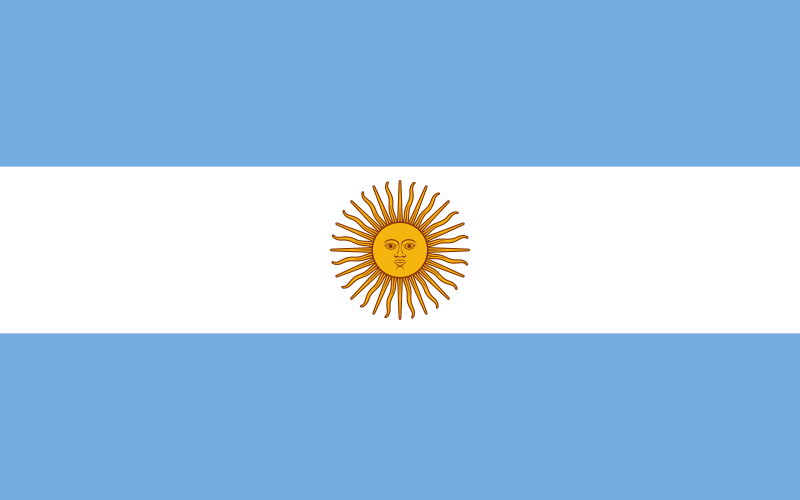
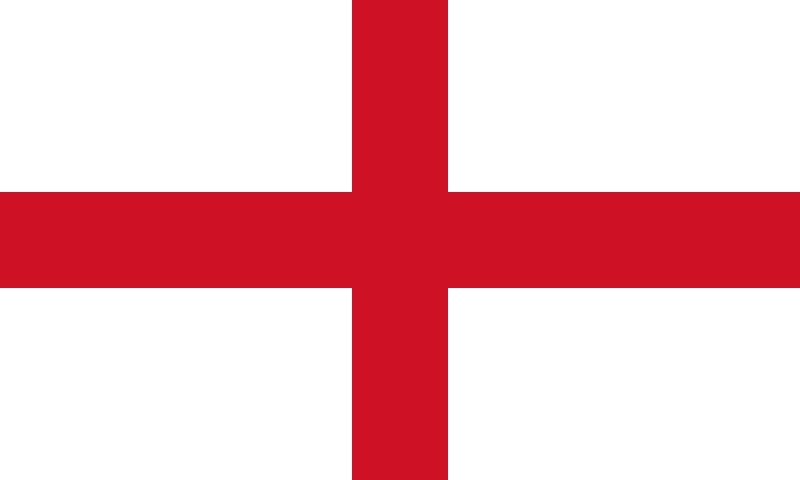
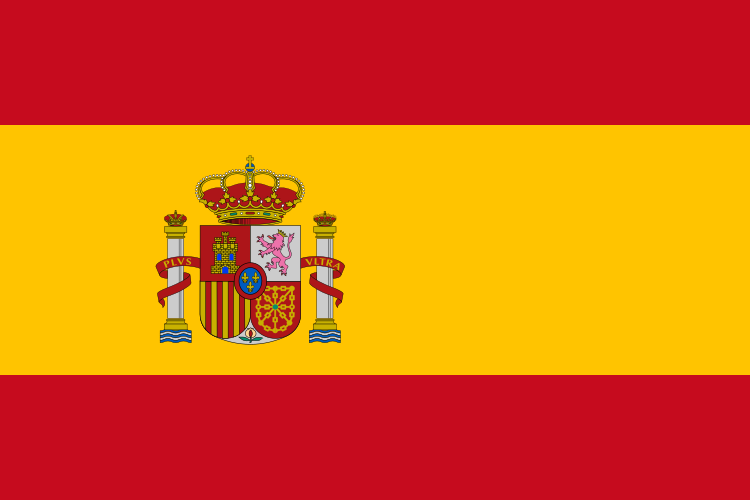
The final four nations — England, France, Spain, and Argentina — contain 41 Premier League players between them. England alone account for 21 of the 26 players in their squad, with France, Spain, and Argentina adding a combined 20 more from England's top flight last season.
La Liga is the second most-represented league, with 29 players across the semi-finalists, 17 of whom feature in the Spain squad. Yet in terms of sheer volume, the Premier League stands apart.
Defenders leading the way
The England-based defensive presence is impossible to miss. Argentina can call upon Tottenham Hotspur's Cristian Romero and Manchester United's Lisandro Martinez. France have Arsenal's William Saliba and Aston Villa's Lucas Digne. Spain can rely on Chelsea's Marc Cucurella and Tottenham Hotspur's Pedro Porro.
England's starting outfield back six, plus their goalkeeper, for their 2-1 quarter-final win over Norway all played in the Premier League last season. Nearly 95 percent of England's defensive minutes across the tournament have been logged by Premier League footballers. Argentina (46.8%), Spain (45.5%), and France (43.1%) tell a similar — if less extreme — story.
Attackers based elsewhere
In attack, the picture shifts entirely. France's front three for their 2-0 quarter-final win over Morocco was built around Paris Saint-Germain's Desire Doue, Real Madrid's Kylian Mbappe, and Paris Saint-Germain's Ousmane Dembele, with Bayern Munich's Michael Olise providing further threat.
Spain edged Belgium 2-1 with a front line of Alex Baena (Atletico Madrid), Mikel Oyarzabal (Real Sociedad), and Lamine Yamal (Barcelona), supported by Barcelona's Dani Olmo. Argentina saw off Switzerland 3-1 through a front two of Julian Alvarez (Atletico Madrid) and Lionel Messi (Inter Miami).
England's forwards present a striking example of the trend. Following Anthony Gordon's departure from Newcastle United to Barcelona, only Noni Madueke and Arsenal's Bukayo Saka remain Premier League-based among their attacking options. Just one of England's starting front four against Norway — Madueke — will play in the Premier League next season.
Goals tell the same story
England have scored 13 goals on their run to the semi-finals. Not one came from a player active in the Premier League last season: Real Madrid's Jude Bellingham contributed six, Bayern Munich's Harry Kane added six, and Marcus Rashford — on loan at Barcelona from Manchester United — scored one. France's tally of 16 goals carries zero from Premier League-based players, while Argentina's and Spain's Premier League contingents have contributed four and three goals respectively.
The debate surfaced on BBC Radio 5 Live's Monday Night Club, where journalist Rory Smith suggested players abroad may benefit from avoiding the Premier League's relentless weekly grind. Former England striker Chris Sutton pushed back, arguing there is no reliable way to measure whether the league's physical demands place players at a disadvantage at major tournaments.
Across the entire tournament, Premier League players have combined for 70 goals and 57 assists — 127 goal involvements in total, ahead of La Liga's 66 and the Bundesliga's 52. The league remains the biggest single supplier of talent at this World Cup. But as the trophy comes into sight, its fingerprints are clearest on back fours — not front threes.
Comments
Share
Premier LeagueFranceSpainArgentinaEnglandNewcastle UnitedFC BarcelonaManchester UnitedLa LigaTottenham HotspurArsenal FCaston villaChelsea FCMarcus rashfordlamine yamalLionel MessiBukayo SakaErling HaalandManchester CityReal MadridJude BellinghamBayern MunichHarry
KaneLiverpool FCReal SociedadCrystal PalaceParis Saint-GermainMoroccoBelgiumbundesliga
Comments
Be the first to comment.