





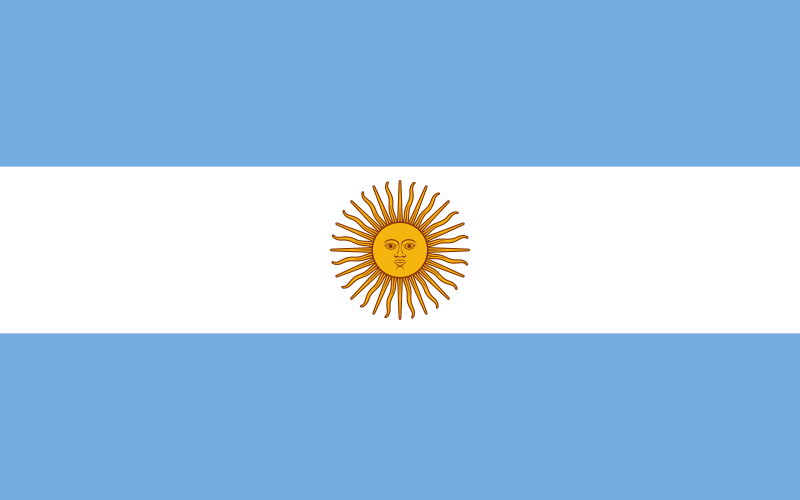








As Spain and Argentina prepare to contest the FIFA World Cup 2026 final, the spotlight has fallen not just on the two finalists but on the venue itself — MetLife Stadium, located in East Rutherford, New Jersey, roughly five miles west of Manhattan.


World Cup 2026
MetLife Stadium: Worthy World Cup Final Host or Overrated Venue?
3 months ago·4 min

As Spain and Argentina prepare to contest the FIFA World Cup 2026 final, the spotlight has fallen not just on the two finalists but on the venue itself — MetLife Stadium, located in East Rutherford, New Jersey, roughly five miles west of Manhattan.
The stadium has drawn sustained criticism throughout the tournament, raising a question many fans and pundits have asked: was it the right choice for football's biggest occasion?
A stadium with a complicated reputation
Among those who know it best, MetLife Stadium has never been beloved. Steve Politi, a long-time New Jersey sports columnist, put it plainly: "For lack of a better word, the technical term for MetLife Stadium is 'blah'." His readers have been even blunter — one compared its exterior to a giant prison toilet, another to a large air conditioner.
Opened in 2010 at a cost of $1.6 billion, the stadium features a metallic louvered façade with programmable lighting, an open-air bowl seating 82,500 spectators, and 200 luxury suites spread across four levels. It is home to the New York Giants and the New Jersey Jets, and its multi-purpose design — built to serve American football, concerts, and major events — has left many feeling it lacks a distinct identity.
The venue sits within a 750-acre complex known as the Meadowlands Sports Complex, surrounded by highways and built on a former swamp. Getting there without a car is a challenge. Fans who relied on rideshares encountered traffic congestion and complex drop-off arrangements, while those who used shuttle buses or the train — around 20,000 per match — reported a more manageable experience, though NJTransit tickets priced at $98 drew widespread complaints.
Pitch concerns cloud the final
Beyond logistics, the playing surface has been a persistent talking point. Natural grass was installed in place of the stadium's usual artificial turf, and during matches, sprinkler systems were visibly activated during hydration breaks to keep the pitch saturated.
Brazil forward Vinicius Jr voiced concerns after his side's 1-1 group-stage draw with Morocco on 13 June, saying the dry surface disrupted the rhythm of play. "We want to move the ball from one side to the other and this disrupts our game," he said. France coach Didier Deschamps was similarly unimpressed following his side's win over Senegal on 16 June, describing the surface as "special" — and not as a compliment. Midfielder Adrien Rabiot likened it to artificial turf in its hardness and rigidity.
FIFA has maintained that all pitches across the tournament have been assessed as healthy and fit for purpose, insisting that visual variations between venues are not a reflection of playability.
The case for New York
Despite the criticisms, the rationale behind choosing MetLife Stadium is clear. Alex Lasry, chief executive of the FIFA World Cup 26 NYNJ Host Committee, argued that New York and New Jersey represent the world's foremost media, entertainment, and economic hub — exactly where FIFA wants to stage its showpiece event.
"What FIFA was looking for was having the biggest stars on the biggest stage," Lasry said, pointing to watch parties planned at Rockefeller Center and Central Park as part of a wider celebration extending far beyond the stadium itself.
Kuba Kowalski, editor in chief of the football architecture website StadiumDB.com, acknowledged the pragmatism of the choice. "It may not be the most romantic football choice, but as a global business decision, it makes a lot of sense," he said. The stadium's location also ensures a kick-off time that suits audiences in both Europe and the Americas — a critical factor for broadcasters and sponsors.
When the crowd arrives, the stadium delivers
MetLife Stadium is also an open-air venue, meaning weather conditions on the day of the final could play a role. Rain was forecast both the day before and after the match, and some fans expressed concern about potential delays if storms arrive during the game.
Politi, for all his reservations about the stadium's charm, believes the occasion can bring out the best in it. "When it is full and when people are engaged and when the game is good, it really is a noisy place, it can rock," he said.
With Spain and Argentina set to deliver one of the most anticipated finals in recent memory, MetLife Stadium will have its chance to prove the doubters wrong.
Comments
Share
Comments
Be the first to comment.