






Hong Myung-bo resigned as South Korea head coach on Sunday, just hours after the Taeguk Warriors' elimination from the 2026 FIFA World Cup was confirmed — issuing a public apology as the fallout from a disastrous tournament began to take shape.


World Cup 2026
South Korean Football in Crisis After World Cup Elimination
4 months ago·4 min

Hong Myung-bo resigned as South Korea head coach on Sunday, just hours after the Taeguk Warriors' elimination from the 2026 FIFA World Cup was confirmed — issuing a public apology as the fallout from a disastrous tournament began to take shape.
The crisis extends beyond one coach's exit. Former Manchester United star Park Ji-sung captured the national mood, saying: "It is miserable that we've come to this moment where we have to look back and ask why we ended up here." Reports have emerged of death threats against Hong, while the arrival locations of players and staff returning to South Korea were kept secret for their safety.
A group stage to forget
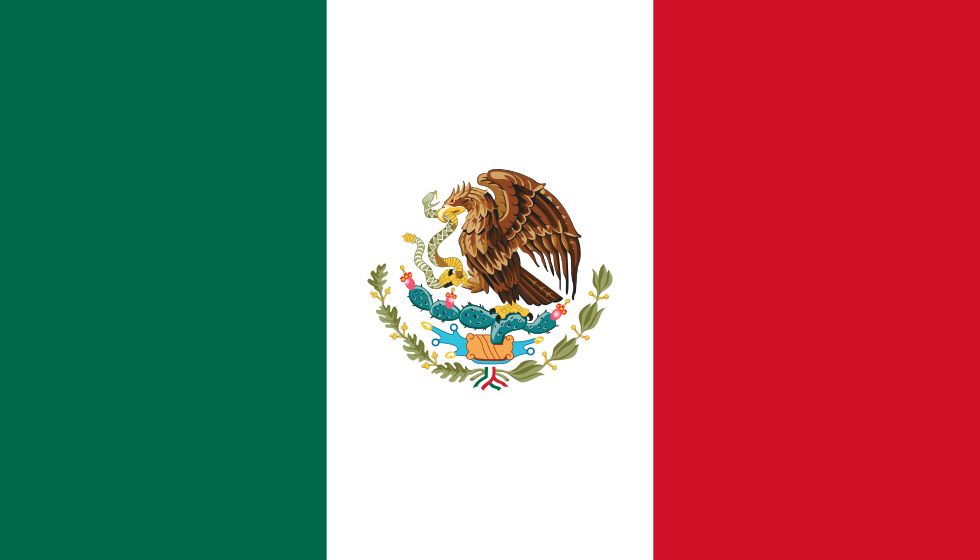
South Korea began their Group A campaign with a 2-1 victory over the Czech Republic, raising hopes for a side featuring Son Heung-min, Paris Saint-Germain's Lee Kang-in, and Bayern Munich defender Kim Min-jae. Those hopes collapsed quickly — a 1-0 defeat to Mexico left them needing a point against South Africa to advance.
Hong, who also oversaw a group-stage exit at the 2014 World Cup, elected to leave captain Son on the bench. South Korea lost. Former Tottenham Hotspur defender Lee Young-pyo called it on television "the worst match by a Korean football team in the 21st century." After the game, a reporter reportedly asked whether food poisoning had struck the camp — searching for any explanation for the performance.
The squad then endured an agonising wait of more than three days to discover whether they would advance as one of the best third-placed finishers. They did not. The camp had already been troubled by an earlier incident in June, when media personnel were caught on camera mocking Son's military service exemption — earned through the team's gold medal at the 2018 Asian Games. Players responded by boycotting domestic media duties for several days. Son, who turns 34 in July, may soon retire from international football. A planned welcome ceremony at Incheon International Airport was cancelled.
Presidential intervention and governance questions
South Korean President Lee Jae-myung took the extraordinary step of posting a statement on social media, saying he felt "not just confusion but utter bewilderment at the unexpected outcome," and describing the early exit as "a failure of organisation and personnel." He added: "When favouritism and cronyism take precedence over competence in selecting a commander, the result is as predictable as fire burning paper."
The spotlight fell on Korea Football Association (KFA) president Chung Mong-gyu, who has held the role since 2013. Chung bypassed standard hiring procedures when appointing Hong in July 2024 — just as he had done when hiring Jurgen Klinsmann a year earlier — prompting accusations of a lack of fairness and transparency. Hong was booed during his first game in charge against Palestine in Seoul in September 2024, and the mood never recovered.
The Ministry of Sports launched an investigation into the KFA and, in November 2024, recommended Chung's suspension. The KFA secured a court injunction allowing Chung to contest — and win — a fourth term in February 2025. He announced in May that he would step down after the World Cup, acknowledging "various controversies and criticisms" during his tenure. Chung is a member of the family that owns Hyundai, a conglomerate with deep historical ties to the KFA.
Japan races ahead
The depth of South Korea's decline becomes starker when set against Japan's rise. For decades, South Korea led the way in Asian football — the K League, founded in 1983, was Asia's first professional league, a full decade before the J League launched. Korean clubs dominated continental competitions while Japan followed behind.
That picture has changed dramatically. In October, Brazil beat South Korea 5-0 in Seoul, then lost 3-2 in Tokyo days later. In March, while South Korea suffered a 4-0 defeat to Ivory Coast, Japan became the first Asian nation to beat England, winning 1-0 at Wembley. J League clubs now routinely outperform their K League counterparts in Asian competitions, and Japan export more talent to Europe — with their national squad now composed entirely of European-based players.
One South Korean fan summarised the frustration on social media: "Japan has a 100-year vision with everyone working together while Korea goes from coach to coach under the whim of one person who does not know anything about football."
With no head coach, no federation president, and a public demanding change, South Korea face a profound reckoning. The pain of the 2026 World Cup may — if the right decisions are made — mark the beginning of a genuine rebuild for Asia's most historically successful World Cup nation, which has made 11 consecutive appearances on football's biggest stage.
Comments
Share
Korea RepublicFIFA World Cup 2026Manchester Unitedson heung-minParis Saint-GermainBayern MunichMexicoSouth AfricaTottenham HotspurJapanBrazilIvory CoastEngland
Comments
Be the first to comment.