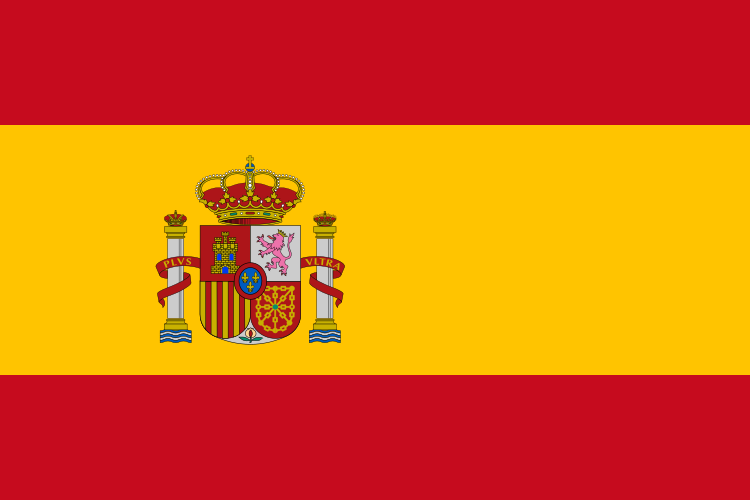
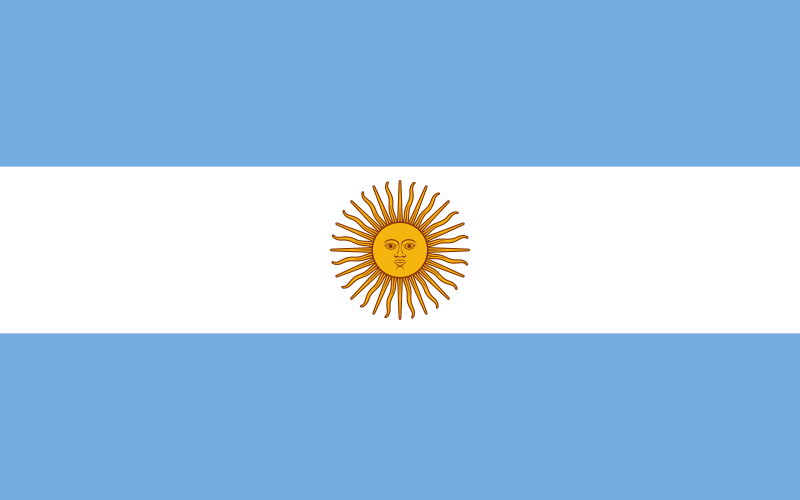


The FIFA World Cup 2026, a record-breaking tournament spanning the United States, Canada, and Mexico, has come to a close — and Spain are its champions for a second time in their history. Spain defeated Argentina 1-0 in extra time in the final, held at the New York-New Jersey stadium, to claim one of football's most coveted prizes.


World Cup 2026
Spain Are World Champions Again After Beating Argentina in Extra Time
13 hours ago·2 min

The FIFA World Cup 2026, a record-breaking tournament spanning the United States, Canada, and Mexico, has come to a close — and Spain are its champions for a second time in their history. Spain defeated Argentina 1-0 in extra time in the final, held at the New York-New Jersey stadium, to claim one of football's most coveted prizes.
Messi's farewell to the World Cup stage
Reflecting on the tournament, chief football writer at the i paper Daniel Storey described the experience of watching Lionel Messi — potentially for the final time at a World Cup — as a genuine privilege. Storey covered the event extensively via a lengthy road trip across the United States, taking in the scale and spectacle of a 48-team competition like no other before it.
Storey also raised concerns about the financial accessibility of the tournament, arguing that FIFA must take meaningful steps to tackle the issue of high ticket prices ahead of future editions, to ensure that ordinary fans are not priced out of the game's biggest event.
How America embraced the World Cup
CBS Sport's Lisa Carlin offered an upbeat assessment of how the tournament landed with American audiences, noting that the United States took to hosting the World Cup with enthusiasm. She also had kind words for the half-time show during the final — a production that drew considerable attention for featuring pop star Justin Bieber, Brazilian football legend Ronaldo, and the Muppets in what many described as a characteristically bold FIFA spectacle.
The expanded 48-team format made its full debut at this tournament, bringing nations from every corner of the globe to stadiums across three countries. The sheer scale of the competition defined the six weeks of action, giving fans a breadth of football not seen at any previous World Cup.
A tournament that transcended the scoreline
Throughout the competition, BBC World Service's More than the Score podcast — hosted by Mike McCarthy alongside guests including Storey and Carlin — went beyond the results to explore the new teams, standout stars, cultural trends, and passionate fan communities that shaped the tournament in ways the statistics alone cannot capture.
Spain's victory marks a remarkable return to the summit of world football for a side that last lifted the trophy in 2010. Argentina and Lionel Messi, meanwhile, finish as runners-up — denied a second consecutive World Cup triumph in the most dramatic of fashion.
Comments
Share
Comments
Be the first to comment.