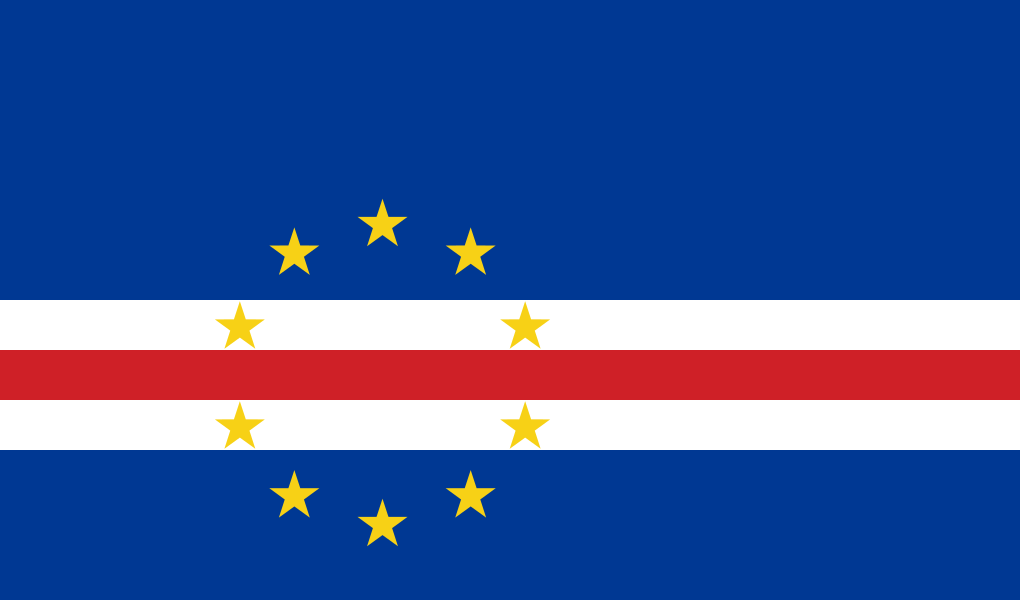

There is a particular kind of joy that belongs to the small nations at a World Cup — one that even neutral fans feel in the marrow of their bones. Cape Verde's run to the round of sixteen at the 2026 FIFA World Cup has become exactly that kind of story.


World Cup 2026
Cape Verde Are Everyone's Team at the 2026 World Cup
2 hours ago·2 min
There is a particular kind of joy that belongs to the small nations at a World Cup — one that even neutral fans feel in the marrow of their bones. Cape Verde's run to the round of sixteen at the 2026 FIFA World Cup has become exactly that kind of story.
The Blue Sharks arrived at this tournament as underdogs by every measure. A nation of roughly 500,000 people spread across a chain of Atlantic islands, Cape Verde has built something quietly extraordinary on the football pitch. Their qualification alone was cause for celebration across the African continent.
Why the world roots for them
The biggest nations arrive at a World Cup carrying the weight of expectation — billions of supporters, corporate machines, decades of history. The small nations carry something lighter and more powerful: the dream of the impossible.
When Cape Verde kept a clean sheet, when they held a lead against opposition ranked far above them in the FIFA standings, neutral fans worldwide found themselves checking the score. That is the magic these sides bring to a tournament that can otherwise feel like a procession for the powerful.
Cape Verde's squad is built largely on players who ply their trade in Portugal and across Europe's mid-tier leagues — professionals who grew up dreaming of this stage. For them, a knockout-round berth is not a stepping stone. It is the destination itself.
A continental source of pride
Across Africa, Cape Verde's progress resonated far beyond the archipelago. In Dakar, in Kinshasa, in Lagos and Nairobi, supporters who had no direct tie to the Blue Sharks watched with the warmth reserved for a younger sibling doing something remarkable.
That is what the smaller nations provide that no amount of star power can manufacture: genuine, unscripted emotion. There is no commercial calculation in a Cape Verdean midfielder sprinting toward the corner flag to celebrate a goal that his country has been waiting a generation to score at this level.
The 2026 World Cup, co-hosted across the United States, Canada, and Mexico, has offered the expanded 48-team format its first true test — and Cape Verde have answered the central question. Yes, the bigger group stage means more minnows. And yes, those minnows matter. They are not filler. They are the soul of the competition.
The big nations win it, the small ones make it
A World Cup without its Cinderella stories would be a lesser tournament. History remembers Cameroon in 1990, Senegal in 2002, Ghana in 2010 — moments when an African side reminded the world that football's hierarchy is never truly settled on any given day.
Cape Verde are writing their own chapter now. Whether their run extends further or ends here, they have already given the world something that cannot be bought or seeded into a bracket: the sight of a small island nation competing — and belonging — on football's grandest stage.
Comments
Share
Comments
Be the first to comment.