


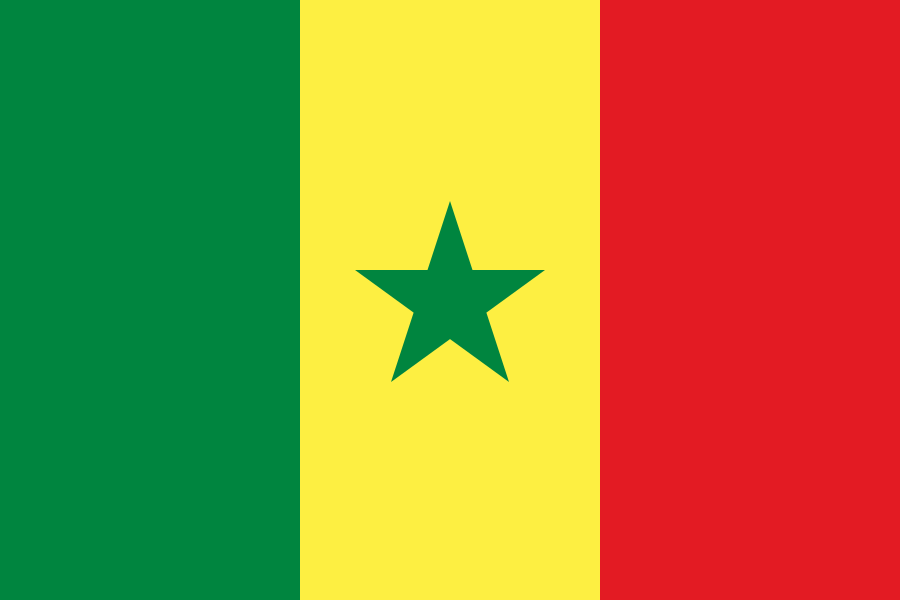


Scotland's FIFA World Cup 2026 campaign is effectively over after Senegal's 5-0 demolition of Iraq in Toronto on Friday ended any lingering hope for Steve Clarke's side. That result pushed Senegal above Scotland in the third-placed standings, sending the Scots tumbling out of the top eight third-place finishers who advance to the round of 32.


World Cup 2026
Scotland Pay the Price as World Cup 2026 Format Creates Uneven Playing Field
2 hours ago·3 min

Scotland's FIFA World Cup 2026 campaign is effectively over after Senegal's 5-0 demolition of Iraq in Toronto on Friday ended any lingering hope for Steve Clarke's side. That result pushed Senegal above Scotland in the third-placed standings, sending the Scots tumbling out of the top eight third-place finishers who advance to the round of 32.
Scotland had already played their final group match and could do nothing but watch. Their fate was sealed by a goal difference left badly damaged after conceding heavily against Brazil and scoring too few in their only win, against Haiti. Senegal's emphatic victory also leapfrogged South Korea, whose knockout-stage hopes now dim alongside Scotland's.
A structural flaw at the heart of the tournament
The expansion of the FIFA World Cup to 48 teams — split into 12 groups of four — has generated a fundamental problem in the group stage. With 24 teams advancing, 12 group winners and 12 runners-up fill the first 24 slots of the round of 32. The remaining eight spots go to the best third-placed finishers from across all 12 groups.
This means teams with identical points totals are ranked against each other despite having played in entirely separate groups, against different opponents, in different conditions. It is a direct comparison of incomparable records — and the timing of matches only deepens the inequity.
Among the completed first six groups — Groups A through F — only South Korea in Group A and Scotland in Group C finished third with three points. Teams such as Bosnia and Herzegovina, Paraguay, Ecuador, and Sweden managed four points in third place, giving themselves a cushion Scotland never had.
The late-group advantage
The core issue is one of information. Teams in later groups play knowing exactly what targets they need to hit in order to advance at the expense of teams who have already finished. Senegal knew that a heavy win over Iraq would lift them into the top eight; Scotland, having already completed their group, had no equivalent opportunity to respond.
This is not unprecedented in major tournaments. Similar dynamics surfaced at Euro 2016, Euro 2020, and Euro 2024, as well as at the 1994 FIFA World Cup — the last time the United States hosted the tournament — where the format also left some third-placed teams exposed to later results.
There is no definitive proof that teams in early groups suffer a measurable disadvantage simply by virtue of their draw. Results across multiple tournaments show that teams have progressed from early groups and been eliminated from late ones. Yet the structural possibility that a team in a later group can target a specific scoreline to displace a side that has no means of replying represents a layer of uncertainty that undermines the integrity of a format meant to reward merit.
Scotland have only themselves to blame for the goal difference that left them vulnerable. But the format handed Senegal a clarity of purpose — and a clock to play against — that Clarke's side never had. That imbalance, however unintentional, sits awkwardly alongside any claim that the group stage is a level playing field.
Comments
Share
Comments
Be the first to comment.