

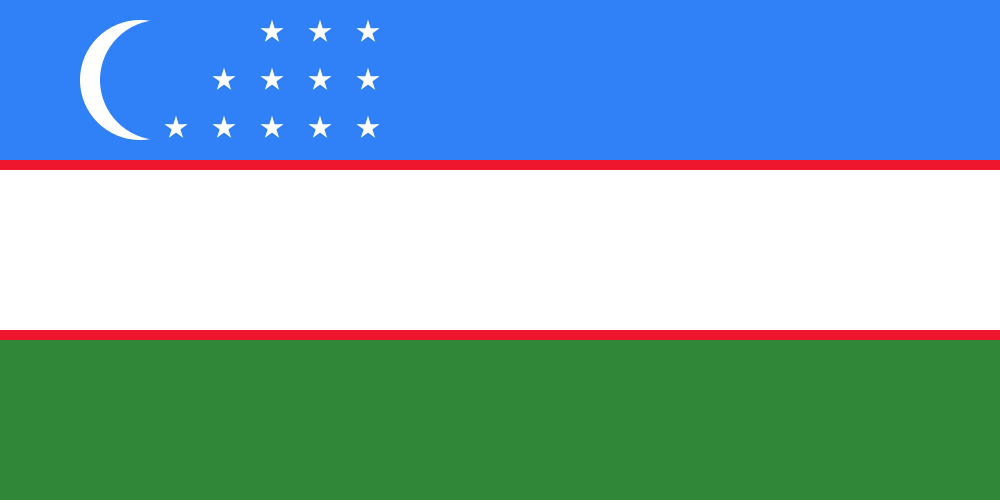

Central Asia will be represented at a FIFA World Cup for the first time in history after Uzbekistan sealed qualification on 5 June 2025. A goalless draw with the United Arab Emirates sparked jubilant celebrations across Tashkent and the wider country, confirming the White Wolves' place at the 2026 FIFA World Cup.


World Cup 2026
Uzbekistan's Historic World Cup Journey: From Heartbreak to the White Wolves' Finest Hour
2 days ago·4 min

Central Asia will be represented at a FIFA World Cup for the first time in history after Uzbekistan sealed qualification on 5 June 2025. A goalless draw with the United Arab Emirates sparked jubilant celebrations across Tashkent and the wider country, confirming the White Wolves' place at the 2026 FIFA World Cup.
A long time coming
Uzbekistan have spent much of this century carrying the painful label of Asian football's "nearly men." Three separate World Cup qualifying campaigns ended in heartbreak — a controversial intercontinental play-off defeat to Bahrain in 2006, a goal-difference elimination behind South Korea in 2014, and another agonising two-point miss in 2018 when South Korea held them to a 0-0 draw in Tashkent on the final matchday.
The 2006 exit remains the most bitter. Uzbekistan won the first leg 1-0, but the referee incorrectly awarded Bahrain a free-kick after an Uzbek player encroached during a penalty — forcing the entire match to be replayed. The replay ended 1-1, the away leg finished 0-0, and Uzbekistan were eliminated on away goals.
Uzbekistan football expert Conor Bowers told BBC Sport that qualification carries an outsized meaning for the nation. "Uzbekistan have historically always been the nearly men of Asian football," Bowers said, adding that success at this level is "as significant as winning it would be for nations like England."
Building from the ground up
The path to the World Cup was the product of deliberate, long-term investment in Uzbek football. Youth teams have excelled on the continental stage, winning the Under-17 and Under-20 Asian Cups, qualifying for the Olympics, and reaching the Under-17 World Cup. The Uzbekistan FA also opened a national training centre outside Tashkent, modelled on the concept of St George's Park in England.
Domestically, the effects are already measurable. Bowers noted that the number of professional clubs in the country rose by 36 percent between 2025 and 2026 alone, with new clubs formed and previously dormant sides re-emerging. "The qualification to the World Cup has not been an overnight success story," Bowers said, describing it instead as the culmination of a structured development plan.
Khusanov — Uzbekistan's Beckham
The most visible symbol of that rise is Abdukodir Khusanov, the defender Manchester City signed from Lens in January 2025 for a fee worth £34 million. At 21, Khusanov has become the face of Uzbek football in the social-media era, with Bowers drawing a direct comparison to the cultural impact David Beckham had in England in the early 2000s.
Forward Jaloliddin Masharipov captured the mood on the streets of Uzbekistan when he told BBC World Service: "He's the first guy in the Premier League in Uzbekistan. All the fans love him. Every time you go outside, go to a restaurant, people come for a picture. You go to a restaurant, you don't pay."
Before Khusanov, the standard-bearer was Server Djeparov — the only Uzbek player ever named Asian Footballer of the Year, an honour he claimed twice — who had trials at Chelsea and featured in all three of those heartbreaking qualifying campaigns.
Cannavaro sets the tone
Italy legend and 2006 World Cup-winning captain Fabio Cannavaro took charge of Uzbekistan in October 2025, succeeding Timur Kapadze. His appointment was initially met with scepticism, but Cannavaro has immersed himself in the role — attending Uzbek Super League matches, meeting Uzbek players abroad, and running multiple training camps.
In March, Cannavaro oversaw a 3-1 friendly win over Gabon at a packed Milliy Stadium and outlined his philosophy without hesitation: "I want warriors. I want high intensity, always. We will go to the World Cup to face top teams and, if people think it's easy, they will make a mistake. It's Uzbekistan's first time at the World Cup and we go to face everyone without fear."
The World Cup and beyond
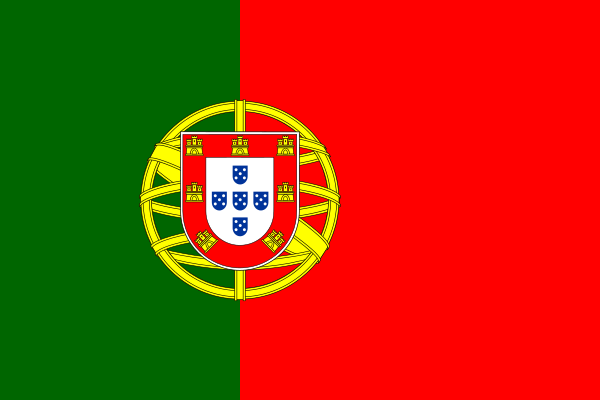
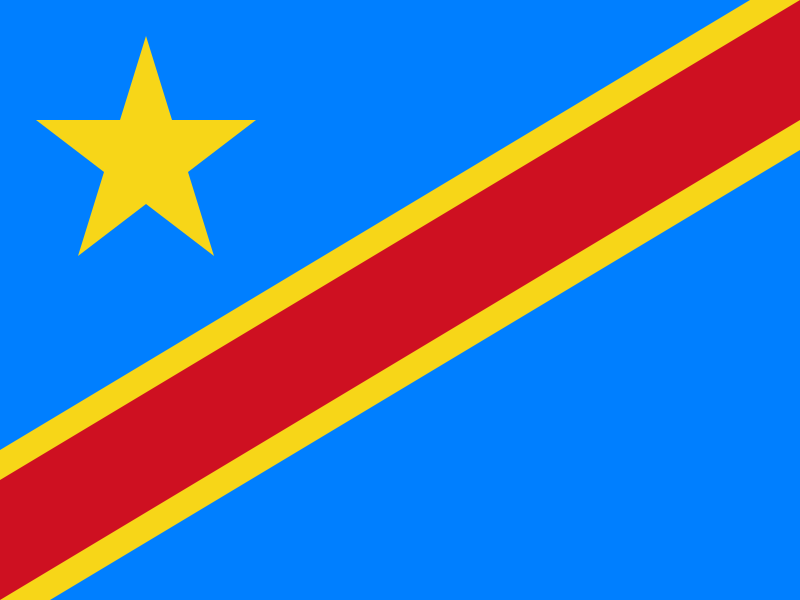
Uzbekistan will enter the tournament in a group alongside Portugal, Colombia, and fellow debutants DR Congo. Bowers insists that simply reaching the finals was the objective: "Qualification was the goal. Anything more than that will be seen as an additional bonus."
Yet the ambitions stretch further than a single tournament. "Uzbekistan should aim for this World Cup to be the first of many and ideally become a regular Asian nation at the tournament like Japan and South Korea," Bowers said. With domestic football expanding, Khusanov flying the flag in Manchester, and the qualifying monkey finally off their backs, few would bet against the White Wolves returning.
Comments
Share
Comments
Be the first to comment.